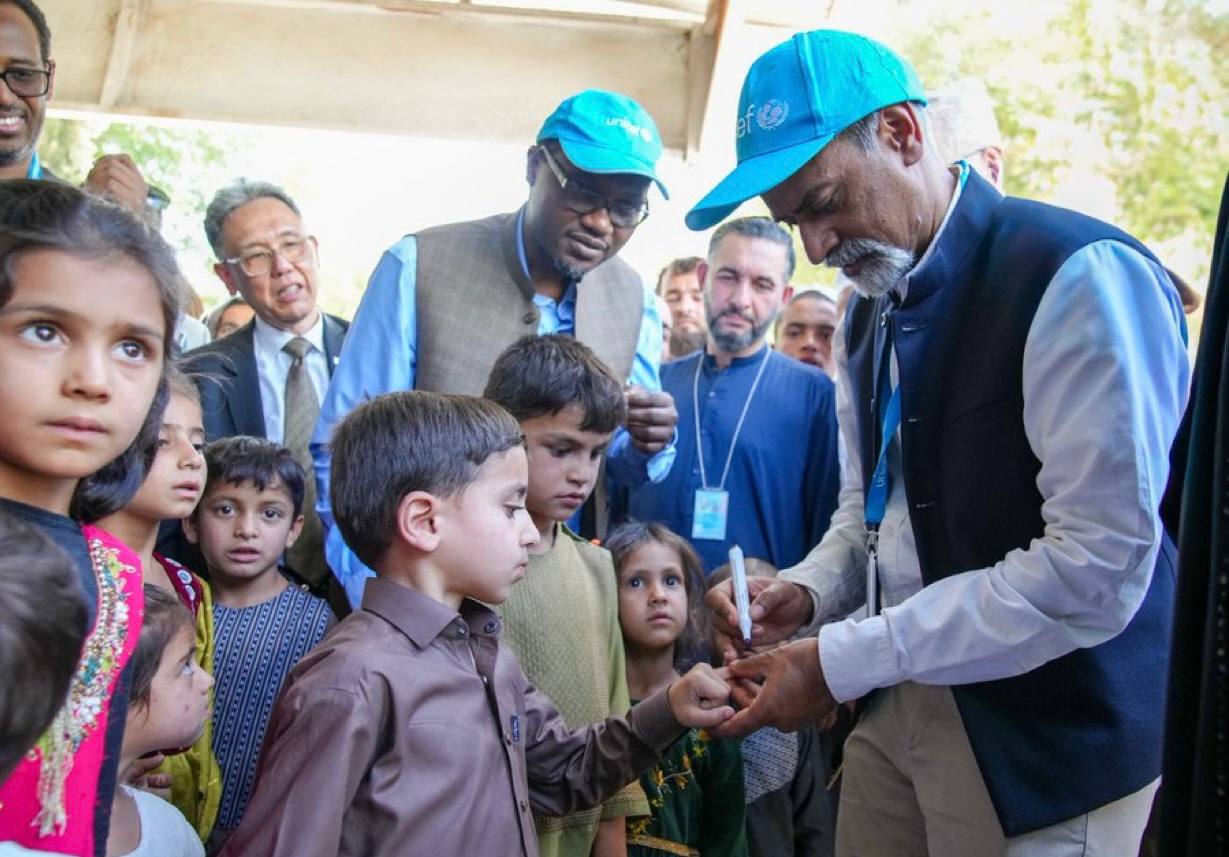
Tajuddin Owais, a representative of UNICEF (the United Nations Children’s Fund), recently announced that Afghanistan has made significant progress in the fight against polio, but efforts to eradicate the disease continue.
Mr. Owais posted a message on his X account stating that during his visit to Kandahar, he met with children and families who participated in polio vaccination programs.
He emphasized that ensuring every child has access to the vaccine brings Afghanistan one step closer to a polio-free future.
UNICEF has expressed gratitude for the support of partners in the Global Polio Eradication Initiative for vaccination programs in Afghanistan.
Additionally, UNICEF has consistently highlighted the importance of efforts to deliver vaccines to all children to prevent the resurgence of this disease.
Afghanistan and Pakistan remain the only two countries in the world where the wild poliovirus is still endemic.
The report indicates that since the beginning of this year, Afghanistan has recorded six cases of polio, while Pakistan has reported three cases. In 2025, Afghanistan had reported 21 cases and Pakistan 31 cases.
The report also notes the continued circulation of the virus in the environment. According to these statistics, Afghanistan has recorded 34 positive environmental samples so far in 2026, while Pakistan has reported 90 positive samples. Environmental monitoring involves testing wastewater samples to detect signs of poliovirus transmission.
This data shows a decrease compared to 2025, when Afghanistan recorded 94 positive environmental samples and Pakistan recorded 651 positive samples.
The World Health Organization stated that one of the recent polio cases in Afghanistan was identified through tracking contacts with the patient, highlighting the importance of surveillance systems in detecting the transmission chain of the virus.