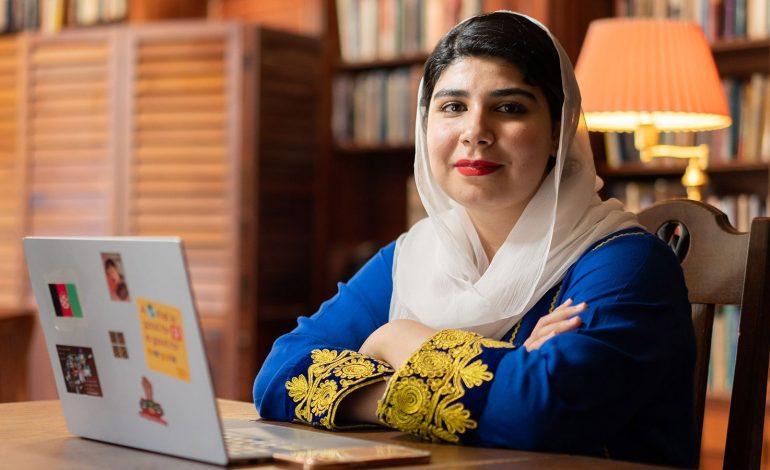
Amnesty International USA has recently announced that its annual award has been granted to Pashtana Durrani, a human rights activist from Afghanistan, and Jazmín Romero Epiayu, a representative of a Colombian feminist movement.
On Saturday (Qaws 1), Amnesty International said in a statement that the award is given to courageous women who work under difficult circumstances to protect the rights of women and children. The award includes a $20,000 grant.
According to the statement, Pashtana Durrani works in the field of girls’ education under the current government and operates the “Learn” school underground.
Pashtana Durrani is a Harvard graduate and the founder of the “Learn” school — the first digital school in Afghanistan, which now operates underground to protect Afghan girls.
She emphasized: “This award belongs to every Afghan girl who still dreams of learning and every woman who refuses to give up her rights.”
She is also the author of the memoir The Last Person Who Eats, the Last Person Who Learns, and has previously received several awards, including the Malala Fund’s Global Education Champion Award and the BBC’s 100 Women Award.
The other winner, Jazmín Romero Epiayu, is a representative of the feminist movement for girls and women of the Wayuu people in Colombia.
The Wayuu are one of the Indigenous communities of northern Colombia and Venezuela, known for their deep-rooted traditions, connection to nature, and colorful handicrafts.
By combining the traditional knowledge of the Wayuu people with modern methods, Jazmín Romero defends the rights of women and girls, as well as the protection of Indigenous lands against violence and illegal resource extraction.
This award is being presented to Pashtana at a time when the current government, after taking control of Afghanistan, has barred women and girls from education. In its latest restriction, it closed the doors of medical institutes to women and girls, even as the health sector across Afghanistan faces a shortage of personnel.
These actions by the current government have left millions of school-age girls deprived of education.
In addition, women have been banned from going to gyms, restaurants, public bathhouses, being examined by male doctors, traveling without a male guardian, and working in domestic and international NGOs and even UN offices in Afghanistan.