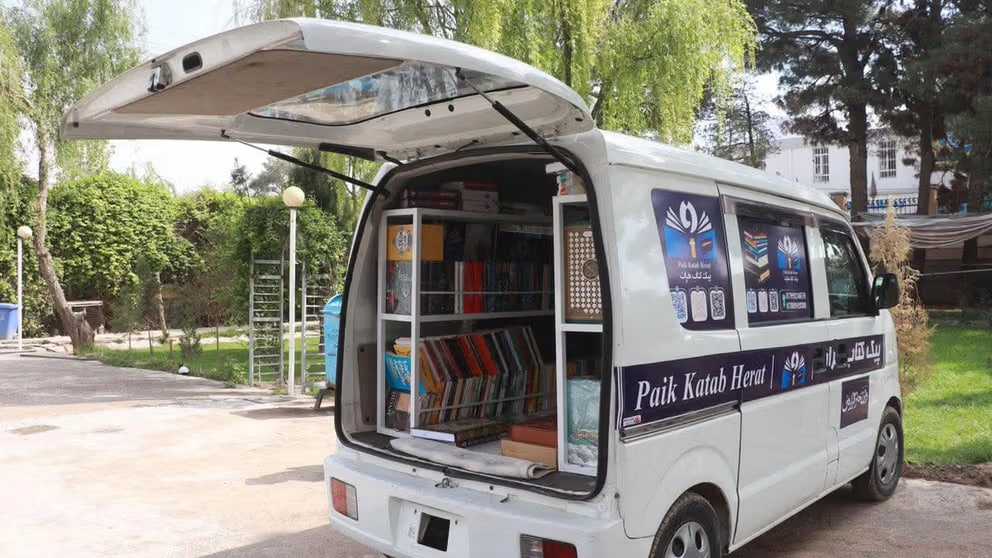
A young man in Herat province has launched a mobile bookstore called “Book Messenger” (Payk-e Ketab) in an effort to promote a culture of reading and make access to books easier for the public.
Ghulam Farooq Mahmoudi has invested 500,000 Afghanis and collected around 2,000 books to establish a mobile library named “Book Messenger.” Through this initiative, he delivers books directly to readers’ homes, aiming to encourage reading and provide easier access to books.
In a video shared online, he can be seen transforming his vehicle into a mobile library, equipping it with shelves similar to those found in public libraries.
This mobile library not only accepts book orders online but also travels to different neighborhoods across the city, delivering books right to people’s doorsteps.
Mahmoudi says that people visit public libraries less frequently, and his method helps make reading more accessible.
Meanwhile, a number of cultural figures in Herat emphasize the importance of supporting booksellers and describe this initiative as an effective step toward promoting a reading culture among the public.
Officials at the Herat Department of Information and Culture also state that they support cultural initiatives and are working to promote reading, especially among young people.
Abdul Mateen Adel, Head of Culture and Arts at the Herat Department of Information and Culture, says: “One of our ongoing efforts is to promote and expand a culture of reading among the people, and we always support individuals who strive in this direction.”
According to booksellers, in recent years, the widespread use of the internet and social media, economic challenges faced by families, and difficulties confronting young people have led to a decline in book sales in Herat.
There is no comprehensive data available on reading rates in Afghanistan.
UNESCO reports that Afghanistan’s literacy rate in 2022 was approximately 37.3 percent; this figure was 22.6 percent for women and 52.1 percent for men.
Additionally, since returning to power, the de facto authorities have closed girls’ secondary schools, leaving around 2.2 million girls deprived of secondary education.